

| Quick Answer AI agents are software systems that take a goal, plan the steps, use tools and data to act, and check their own results with limited human input. Unlike chatbots that only answer questions, agents complete work, such as triaging requests, preparing reports or flagging risks. They deliver real value when they target one clear decision or workflow, run on AI-ready data and include human review for high-impact actions. Gartner predicts more than 40% of agentic AI projects will be canceled by 2027, mostly because those basics were skipped. |
Key Takeaways
- An AI agent plans, acts and checks its work; a chatbot mainly responds.
- Gartner expects 33% of enterprise software applications to include agentic AI by 2028.
- More than 40% of agentic AI projects are expected to be canceled by the end of 2027 due to cost, unclear value and weak risk controls.
- Many products marketed as agents are not. Gartner calls this “agent washing.”
- Start small: one workflow, ready data, measurable outcomes and a human in the loop.
What Are AI Agents?
Most people first met AI through chatbots: you ask, it answers. AI agents go a step further. Give an agent a goal, such as “summarize this week’s field reports and flag any district with rising cases,” and it can work out the steps, pull data from the right systems, run the analysis, draft the summary and route anything unusual to a person for review.
Under the hood, an agent usually combines a large language model for reasoning with access to tools: databases, spreadsheets, email, APIs, maps or predictive models. If you are new to the terms, our guide to AI vs. machine learning vs. data science explains how these pieces fit together.
AI Agent vs. Chatbot vs. Automation: What Is the Difference?
| Chatbot | Rule-Based Automation (RPA) | AI Agent | |
| What it does | Answers questions | Follows fixed, scripted steps | Plans and completes multi-step goals |
| Handles new situations | Limited | No, breaks when inputs change | Yes, within defined limits |
| Uses other tools | Rarely | Yes, in a fixed order | Yes, chooses which tool to use |
| Checks its own output | No | No | Can, when designed to |
| Best for | FAQs and simple support | Stable, repetitive tasks | Variable, judgment-heavy workflows |
How AI agents compare with chatbots and rule-based automation.
Why Everyone Is Talking About AI Agents in 2026
Agentic AI has moved from demos to roadmaps. According to Gartner research reported by SD Times, 33% of enterprise software applications will include agentic AI by 2028, and 15% of day-to-day work decisions will be made autonomously.
The same research carries a warning: more than 40% of agentic AI projects will be canceled by the end of 2027 because of escalating costs, unclear business value or inadequate risk controls. Gartner also estimates that only about 130 of the thousands of vendors claiming agentic AI are delivering it. The rest are “agent washing” existing chatbots and automation tools.
The takeaway is not to wait. It is to build carefully, starting with problems where the value is clear and the data is ready.
Where AI Agents Deliver Real Value: Use Cases by Sector
Business and Commerce
- Triaging customer inquiries and drafting responses for staff approval
- Monitoring sales and inventory data and alerting teams to unusual changes
- Preparing weekly performance reports from several systems automatically
- Flagging potentially fraudulent transactions for human review
Explore our artificial intelligence and business intelligence services.
Healthcare and Public Health
- Scanning surveillance and laboratory data for early outbreak signals
- Summarizing new research and guidance for program teams
- Supporting antimicrobial resistance monitoring with consistent, validated reporting
See how we apply data science to global health and pandemic preparedness and our medical and public health case studies.
Government, Climate and NGOs
- Reviewing large volumes of documents and extracting key facts
- Combining program, geospatial and public data to prioritize field visits
- Drafting donor and progress reports from verified program data
Read our government, climate and NGO case studies.
Is Your Organization Ready for AI Agents?
Answer these seven questions honestly. Three or more “no” answers mean you should start with data and process work first.
- Can you name one specific workflow or decision you want the agent to handle?
- Can you measure success in time saved, errors reduced or outcomes improved?
- Is the data behind that workflow accurate, documented and accessible?
- Do you know which actions an agent may take on its own and which need approval?
- Is there a person who owns the agent’s results?
- Can you log and review what the agent did and why?
- Have you considered privacy, security and regulatory requirements?
Data readiness is the most common gap. Gartner predicts that through 2026, organizations will abandon 60% of AI projects unsupported by AI-ready data. Our guide to decision intelligence explains how to prepare.
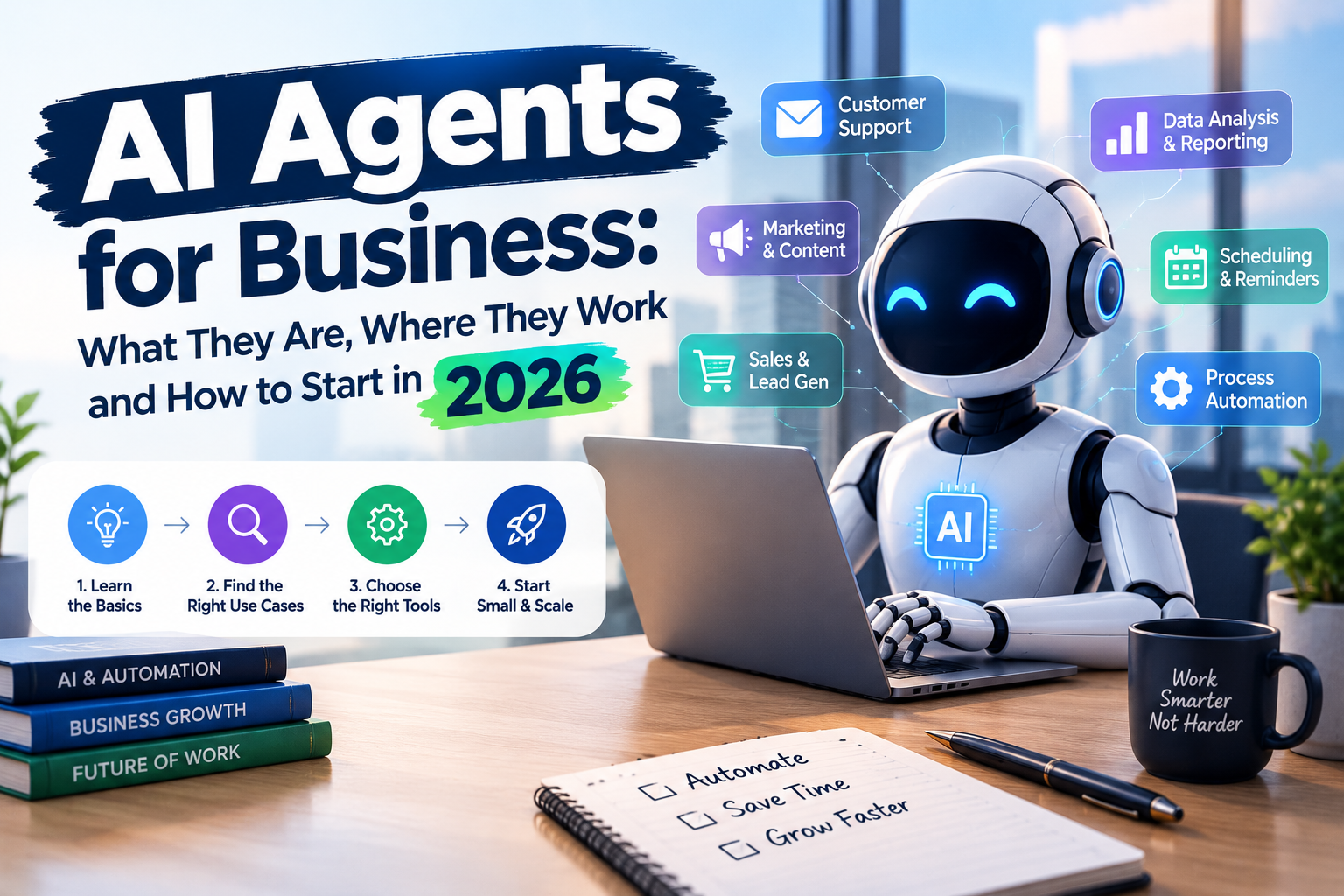
How to Launch an AI Agent the Right Way: 5 Steps
- Define the decision or workflow. Be specific about the goal, the users and what a good result looks like.
- Integrate and check the evidence. Connect the right data sources and fix quality issues before the agent uses them.
- Build with guardrails. Limit which tools and actions the agent can use, and require human approval for high-impact steps.
- Validate before scaling. Test results against expert judgment and real-world outcomes, and corroborate sources.
- Deliver where people work. Put outputs into dashboards, alerts, briefs or APIs your team already uses, then monitor and improve.
Common Mistakes to Avoid
- Buying the label, not the capability. Ask vendors to show the agent planning, using tools and handling exceptions.
- Automating a broken process. Redesign the workflow first; Gartner recommends rethinking workflows rather than retrofitting agents onto legacy ones.
- Skipping human oversight. Autonomy should grow only as trust is earned.
- Ignoring total cost. Model usage, integration and monitoring costs add up. Plan for them up front.
Why Organizations Choose Patira Data Science
Patira Data Science is a global data science and intelligence company with offices in Westerville, Ohio and Kampala, Uganda. We build custom AI solutions, including chatbots, predictive models and recommendation engines, around your real operations. Every engagement includes validation: assessing source quality, corroborating findings and verifying results with experts or in the field. We work across business, healthcare technology, public health, climate, government and NGOs. Learn more in our company overview and research and analytics services, or build your team’s skills through our bioinformatics and statistics training.
Frequently Asked Questions
What is an AI agent in simple terms?
An AI agent is software that can take a goal, plan the steps to reach it, use tools and data to act, and check its own results, with limited human input. A chatbot answers questions; an agent gets work done.
What is the difference between an AI agent and a chatbot?
A chatbot responds to messages, usually one at a time. An AI agent can break a goal into steps, call other systems such as databases, email or APIs, take actions and adjust based on what happens, often across several tools.
Are AI agents worth it for small and mid-sized businesses?
They can be, when they target a specific, repetitive, rules-heavy process with clear value, such as triaging inquiries, preparing reports or reconciling records. Gartner advises pursuing agentic AI only where it delivers clear value or ROI.
Why do so many AI agent projects fail?
Gartner predicts more than 40% of agentic AI projects will be canceled by the end of 2027 because of rising costs, unclear business value and weak risk controls. Poor data quality and unclear goals are common root causes.
What is agent washing?
Agent washing is when vendors relabel existing chatbots, AI assistants or robotic process automation as agentic AI without adding real agentic capabilities. Gartner estimates only about 130 of the thousands of agentic AI vendors are real.
How do I get started with AI agents?
Start with one well-defined decision or workflow, check that the data behind it is ready, run a supervised pilot with clear success measures and add human review for high-impact actions. Patira Data Science helps organizations scope, build and validate custom AI solutions. Call (614) 398-3398 or email hello@patiradatascience.com.
Build an AI Agent That Actually Delivers
| Not sure where an AI agent would help most? Tell us one workflow or decision that costs your team time. We will assess your data, show you what an agent could realistically do and outline a safe, measurable pilot. Talk to an Advisor | Call (614) 398-3398 | Email hello@patiradatascience.com |