
AI Agents for Business

AI Agents for Business: What They Are, Where They Work and How to Start in 2026

By BlogsNo Comments
Quick Answer AI agents are software systems that take a goal, plan the steps, use tools and data to act, and check their own results with limited human input. Unlike chatbots that only answer questions, agents complete work, such as triaging requests, preparing reports or flagging risks. They deliver real value when they target one clear decision or workflow, run on AI-ready data and include human review for high-impact actions. Gartner predicts more than 40% of agentic AI projects will be canceled by 2027, mostly because those basics were skipped.

Key Takeaways

  • An AI agent plans, acts and checks its work; a chatbot mainly responds.
  • Gartner expects 33% of enterprise software applications to include agentic AI by 2028.
  • More than 40% of agentic AI projects are expected to be canceled by the end of 2027 due to cost, unclear value and weak risk controls.
  • Many products marketed as agents are not. Gartner calls this “agent washing.”
  • Start small: one workflow, ready data, measurable outcomes and a human in the loop.

What Are AI Agents?

Most people first met AI through chatbots: you ask, it answers. AI agents go a step further. Give an agent a goal, such as “summarize this week’s field reports and flag any district with rising cases,” and it can work out the steps, pull data from the right systems, run the analysis, draft the summary and route anything unusual to a person for review.

Under the hood, an agent usually combines a large language model for reasoning with access to tools: databases, spreadsheets, email, APIs, maps or predictive models. If you are new to the terms, our guide to AI vs. machine learning vs. data science explains how these pieces fit together.

AI Agent vs. Chatbot vs. Automation: What Is the Difference?

 ChatbotRule-Based Automation (RPA)AI Agent
What it doesAnswers questionsFollows fixed, scripted stepsPlans and completes multi-step goals
Handles new situationsLimitedNo, breaks when inputs changeYes, within defined limits
Uses other toolsRarelyYes, in a fixed orderYes, chooses which tool to use
Checks its own outputNoNoCan, when designed to
Best forFAQs and simple supportStable, repetitive tasksVariable, judgment-heavy workflows

How AI agents compare with chatbots and rule-based automation.

Why Everyone Is Talking About AI Agents in 2026

Agentic AI has moved from demos to roadmaps. According to Gartner research reported by SD Times, 33% of enterprise software applications will include agentic AI by 2028, and 15% of day-to-day work decisions will be made autonomously.

The same research carries a warning: more than 40% of agentic AI projects will be canceled by the end of 2027 because of escalating costs, unclear business value or inadequate risk controls. Gartner also estimates that only about 130 of the thousands of vendors claiming agentic AI are delivering it. The rest are “agent washing” existing chatbots and automation tools.

The takeaway is not to wait. It is to build carefully, starting with problems where the value is clear and the data is ready.

Where AI Agents Deliver Real Value: Use Cases by Sector

Business and Commerce

  • Triaging customer inquiries and drafting responses for staff approval
  • Monitoring sales and inventory data and alerting teams to unusual changes
  • Preparing weekly performance reports from several systems automatically
  • Flagging potentially fraudulent transactions for human review

Explore our artificial intelligence and business intelligence services.

Healthcare and Public Health

  • Scanning surveillance and laboratory data for early outbreak signals
  • Summarizing new research and guidance for program teams
  • Supporting antimicrobial resistance monitoring with consistent, validated reporting

See how we apply data science to global health and pandemic preparedness and our medical and public health case studies.

Government, Climate and NGOs

  • Reviewing large volumes of documents and extracting key facts
  • Combining program, geospatial and public data to prioritize field visits
  • Drafting donor and progress reports from verified program data

Read our government, climate and NGO case studies.

Is Your Organization Ready for AI Agents?

Answer these seven questions honestly. Three or more “no” answers mean you should start with data and process work first.

  • Can you name one specific workflow or decision you want the agent to handle?
  • Can you measure success in time saved, errors reduced or outcomes improved?
  • Is the data behind that workflow accurate, documented and accessible?
  • Do you know which actions an agent may take on its own and which need approval?
  • Is there a person who owns the agent’s results?
  • Can you log and review what the agent did and why?
  • Have you considered privacy, security and regulatory requirements?

Data readiness is the most common gap. Gartner predicts that through 2026, organizations will abandon 60% of AI projects unsupported by AI-ready data. Our guide to decision intelligence explains how to prepare.

How to Launch an AI Agent the Right Way: 5 Steps

  1. Define the decision or workflow. Be specific about the goal, the users and what a good result looks like.
  2. Integrate and check the evidence. Connect the right data sources and fix quality issues before the agent uses them.
  3. Build with guardrails. Limit which tools and actions the agent can use, and require human approval for high-impact steps.
  4. Validate before scaling. Test results against expert judgment and real-world outcomes, and corroborate sources.
  5. Deliver where people work. Put outputs into dashboards, alerts, briefs or APIs your team already uses, then monitor and improve.

Common Mistakes to Avoid

  • Buying the label, not the capability. Ask vendors to show the agent planning, using tools and handling exceptions.
  • Automating a broken process. Redesign the workflow first; Gartner recommends rethinking workflows rather than retrofitting agents onto legacy ones.
  • Skipping human oversight. Autonomy should grow only as trust is earned.
  • Ignoring total cost. Model usage, integration and monitoring costs add up. Plan for them up front.

Why Organizations Choose Patira Data Science

Patira Data Science is a global data science and intelligence company with offices in Westerville, Ohio and Kampala, Uganda. We build custom AI solutions, including chatbots, predictive models and recommendation engines, around your real operations. Every engagement includes validation: assessing source quality, corroborating findings and verifying results with experts or in the field. We work across business, healthcare technology, public health, climate, government and NGOs. Learn more in our company overview and research and analytics services, or build your team’s skills through our bioinformatics and statistics training.

Frequently Asked Questions

What is an AI agent in simple terms?

An AI agent is software that can take a goal, plan the steps to reach it, use tools and data to act, and check its own results, with limited human input. A chatbot answers questions; an agent gets work done.

What is the difference between an AI agent and a chatbot?

A chatbot responds to messages, usually one at a time. An AI agent can break a goal into steps, call other systems such as databases, email or APIs, take actions and adjust based on what happens, often across several tools.

Are AI agents worth it for small and mid-sized businesses?

They can be, when they target a specific, repetitive, rules-heavy process with clear value, such as triaging inquiries, preparing reports or reconciling records. Gartner advises pursuing agentic AI only where it delivers clear value or ROI.

Why do so many AI agent projects fail?

Gartner predicts more than 40% of agentic AI projects will be canceled by the end of 2027 because of rising costs, unclear business value and weak risk controls. Poor data quality and unclear goals are common root causes.

What is agent washing?

Agent washing is when vendors relabel existing chatbots, AI assistants or robotic process automation as agentic AI without adding real agentic capabilities. Gartner estimates only about 130 of the thousands of agentic AI vendors are real.

How do I get started with AI agents?

Start with one well-defined decision or workflow, check that the data behind it is ready, run a supervised pilot with clear success measures and add human review for high-impact actions. Patira Data Science helps organizations scope, build and validate custom AI solutions. Call (614) 398-3398 or email hello@patiradatascience.com.

Build an AI Agent That Actually Delivers

Not sure where an AI agent would help most? Tell us one workflow or decision that costs your team time. We will assess your data, show you what an agent could realistically do and outline a safe, measurable pilot. Talk to an Advisor  |  Call (614) 398-3398  |  Email hello@patiradatascience.com

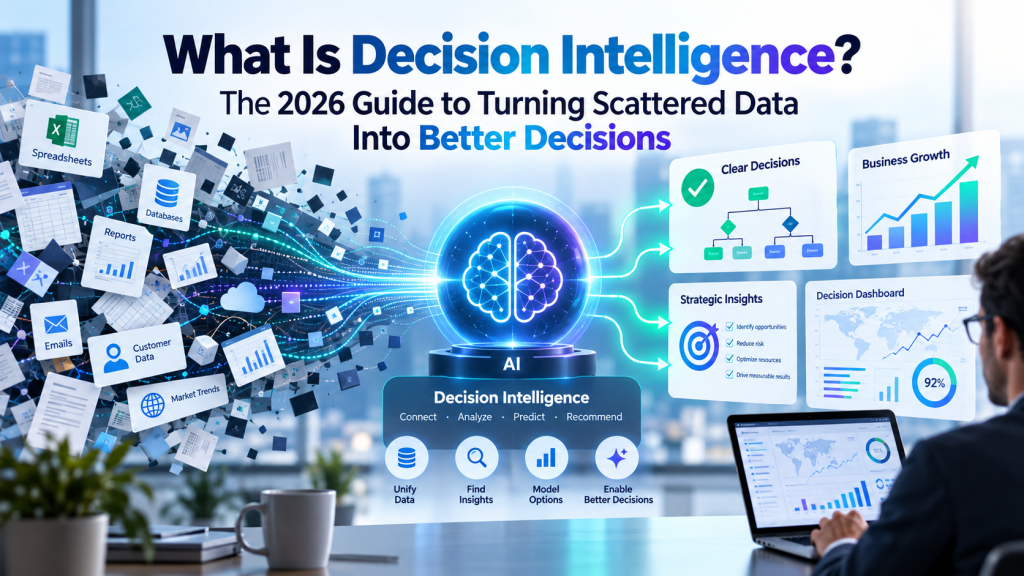
What Is Decision Intelligence? The 2026 Guide to Turning Scattered Data Into Better Decisions

By BlogsNo Comments
Quick Answer Decision intelligence is the practice of designing important decisions first, then using data science, AI, statistics and domain expertise to support them. Unlike business intelligence, which reports on the past, decision intelligence combines scattered data into validated recommendations, forecasts and alerts that tell leaders what to do next. In 2026, it is how organizations get real value from AI instead of more dashboards.

Key Takeaways

  • Decision intelligence starts with the decision, not the data.
  • It goes beyond business intelligence by predicting outcomes and recommending actions.
  • Gartner predicts that through 2026, organizations will abandon 60% of AI projects unsupported by AI-ready data.
  • Validation, meaning checking source quality and confirming findings with experts, is what makes recommendations trustworthy.
  • Patira Data Science builds decision intelligence for businesses, governments, NGOs and health programs across the US and Uganda.

What Is Decision Intelligence?

Most organizations are not short on data. They are short on clear answers. Sales figures sit in one system, field reports in another, public datasets and maps somewhere else. Leaders still end up deciding on instinct because nobody has connected the pieces.

Decision intelligence fixes that. TechTarget describes it as a field that “combines data science, artificial intelligence (AI) and decision theory to improve organizational decision-making.” Gartner frames it more narrowly as “the process of documenting and engineering how decisions are made.” Both point to the same shift: build the analytics around a decision someone actually has to make.

Decision Intelligence vs. Business Intelligence vs. Data Science

QuestionBusiness IntelligenceData ScienceDecision Intelligence
Main goalReport what happenedFind patterns and build modelsImprove a specific decision
Typical outputDashboards and reportsModels and analysesRecommendations, forecasts, alerts, APIs
LooksBackwardBackward and forwardForward, tied to action
Data sourcesMostly internal systemsWhatever the project needsInternal, public, geospatial and research data, integrated
Who uses itAnalysts and managersData teamsDecision-makers at every level
AutomationRarelySometimesCan automate routine decisions under set rules

Decision intelligence vs business intelligence vs data science compared.

New to the terminology? Our guide to AI vs. machine learning vs. data science explains how these fields fit together.

Why Decision Intelligence Matters in 2026

AI budgets are growing, but results are uneven. According to Gartner, “through 2026, organizations will abandon 60% of AI projects unsupported by AI-ready data,” and 63% of organizations either do not have, or are unsure whether they have, the right data management practices for AI.

The lesson is clear. Buying an AI tool does not create better decisions. Organizations that win define the decision, prepare the right evidence and validate the output before anyone acts on it. That is exactly what decision intelligence is designed to do.

What Does AI-Ready Data Look Like?

AI-ready data is not simply “a lot of data.” It is data that fits the decision you want to make. In practice, it has five qualities:

QualityWhat It MeansWarning Sign
RelevantCovers the people, places and time periods the decision affectsModels trained on data from a different market or population
AccurateErrors, duplicates and gaps are measured and fixedTeams argue over which report has the right number
DocumentedSources, definitions and update schedules are recordedOnly one analyst knows how a key table was built
GovernedClear ownership, access rules and privacy controlsSensitive records shared by email or spreadsheet
ConnectedInternal, public and geospatial sources can be linkedEvery dataset uses different IDs, names or formats

The five qualities of AI-ready data for decision intelligence.

Getting these right is usually the fastest way to make an existing AI investment start paying off.

How Does Decision Intelligence Work?

At Patira, every decision intelligence engagement follows five steps:

  1. Understand the decision problem. Define the operational, policy, research or business decision the system must support, and who makes it.
  2. Integrate the evidence. Combine institutional records, public data, geospatial layers and research findings into one view.
  3. Build the intelligence. Apply data science, AI, GIS, statistics and domain expertise to forecast outcomes and compare options.
  4. Validate. Assess source quality, corroborate findings and verify results with experts or in the field.
  5. Deliver decision support. Put answers where people work: dashboards, alerts, briefs, models, APIs or integrated systems.

Decision Intelligence Examples by Sector

Business and Commerce

Retailers and service companies use decision intelligence for pricing and revenue optimization, demand forecasting, churn prediction, fraud detection and root-cause analysis of customer experience problems. Explore our business intelligence and artificial intelligence services.

Public Health and Medicine

Health programs combine clinical, laboratory and surveillance data to spot outbreaks early, track antimicrobial resistance and target scarce resources. Patira’s One Health work on pandemic preparedness and AMR applies this approach. See our medical and public health case studies.

Government, Climate and NGOs

Public agencies and development organizations use geospatial evidence and program data to decide where to invest, which communities are most at risk and whether interventions are working. Read our government, climate and NGO case studies.

Research

Research teams use statistics and bioinformatics to turn complex datasets into publishable, defensible conclusions. Patira also offers bioinformatics and statistics training to build in-house capability.

Is Your Organization Ready for Decision Intelligence?

Use this quick checklist. If you answer “no” to three or more, start with a data readiness review before investing in AI.

  • Can you name the top three decisions you want to improve this year?
  • Do you know where the data behind those decisions lives?
  • Is that data accurate, documented and updated on a schedule?
  • Can you combine internal records with public or geospatial data?
  • Does someone own data quality and governance?
  • Will decision-makers trust a recommendation they did not build themselves?
  • Do you have a way to measure whether decisions improved?

Common Mistakes to Avoid

  • Starting with the tool instead of the decision. Technology chosen first rarely fits the real problem.
  • Building more dashboards. If nobody acts on a chart, it is not decision support.
  • Skipping validation. Unverified sources create confident but wrong answers.
  • Ignoring the people. Recommendations must fit how teams actually work, or they will be ignored.

Avoiding these four mistakes matters more than choosing any single platform, model or vendor. The best decision intelligence systems are simple, trusted and used every day.

Why Organizations Choose Patira Data Science

Patira Data Science is a global data science and intelligence company with offices in Westerville, Ohio and Kampala, Uganda. We integrate institutional, public, geospatial and research evidence into one intelligence system, validate it with expert and field verification, and deliver it in the format your team will use. Our work spans business, healthcare technology, public health, climate and environment, government and NGOs. Learn more about Patira or explore our research and data analysis services.

Frequently Asked Questions

What is decision intelligence in simple terms?

Decision intelligence is the practice of designing decisions first, then using data science, AI and domain expertise to support them. Instead of producing more reports, it delivers recommendations, forecasts and alerts tied to a specific decision someone has to make.

How is decision intelligence different from business intelligence?

Business intelligence reports on what already happened through dashboards and reports. Decision intelligence adds predictive models, AI and decision design to recommend what to do next, and can automate routine decisions based on set rules.

Is decision intelligence the same as AI?

No. AI is one of the tools decision intelligence uses. Decision intelligence also relies on statistics, geospatial analysis, validated data sources and human expertise to make sure recommendations are trustworthy.

What does AI-ready data mean?

AI-ready data is data that is accurate, well-documented, governed and representative of the problem you want to solve. Gartner predicts that through 2026, organizations will abandon 60% of AI projects unsupported by AI-ready data.

Which industries use decision intelligence?

Decision intelligence is used in retail, finance, healthcare, public health, government, climate and environment programs, NGOs and research, anywhere repeated decisions depend on large or scattered data.

How do I get started with decision intelligence?

Start with one high-value decision, map the data behind it and run a focused pilot. Patira Data Science helps organizations scope the decision, integrate and validate the evidence, and deliver dashboards, alerts, models or APIs. Call (614) 398-3398 or email hello@patiradatascience.com.

Turn Your Data Into Decisions

Have too much data and not enough answers? Tell us the decision you need to get right. We will show you what evidence you already have, what is missing and how decision intelligence can close the gap. Talk to an Advisor  |  Call (614) 398-3398  |  Email hello@patiradatascience.com
AI vs Machine Learning vs Data Science

AI, Machine Learning and Data Science: What Is the Difference, and Which Should You Learn?

By BlogsNo Comments

The terms get used interchangeably and they are not the same thing. Here is how they actually relate, and how to pick a starting point.

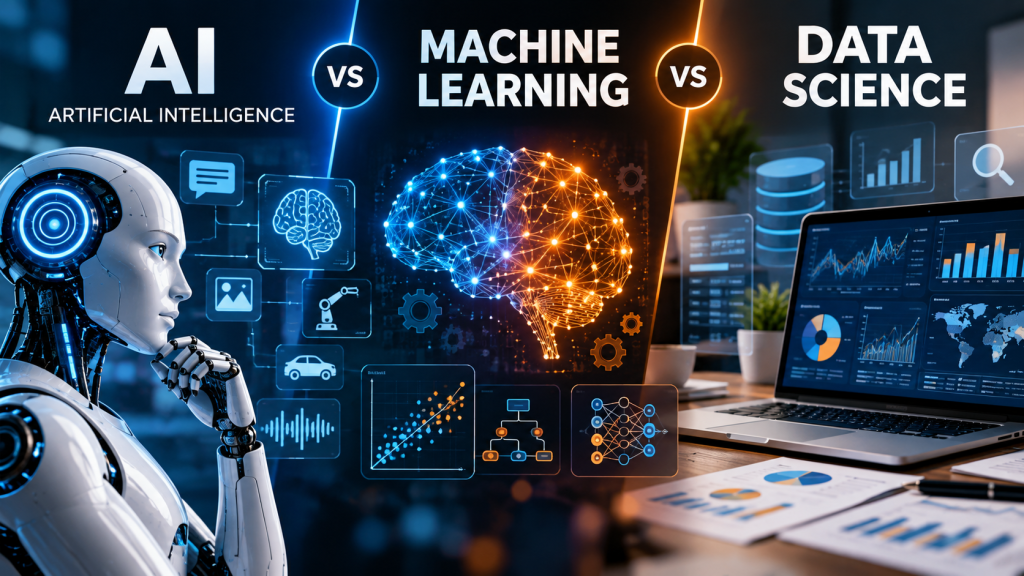
QUICK ANSWER Artificial intelligence is the broad field of building systems that perform tasks normally requiring human intelligence. Machine learning is a subset of AI, where systems learn patterns from data rather than following rules written by a programmer. Deep learning is a subset of machine learning that uses neural networks, and it is what powers most of what people now call AI. Data science is different in kind rather than scope: it is the practice of extracting insight from data, using statistics, analysis and often machine learning as one of its tools. Put simply, AI is the goal, machine learning is a method, and data science is a discipline that uses both alongside statistics and domain knowledge.

If you are trying to decide what to learn, the first obstacle is that everyone uses these words loosely. Job postings say AI when they mean analytics. Courses say data science when they teach machine learning. Marketing says machine learning when it means a formula in a spreadsheet.

The distinctions matter because they lead to different jobs, different skills and different amounts of time to get there.

How they actually relate

The cleanest way to picture it is as nested circles, with one exception.

Artificial intelligence is the outermost circle, covering any system that performs tasks associated with human intelligence. Machine learning sits inside it, covering systems that learn from data instead of following explicit rules. Deep learning sits inside machine learning, using layered neural networks, and it is behind most recent progress including large language models.

Data science does not sit neatly inside any of them. It overlaps. A data scientist uses statistics, data manipulation, visualisation and domain knowledge to answer questions, and machine learning is one tool in that set rather than the whole job. Plenty of valuable data science work involves no machine learning at all.

 What it isCore skillTypical output
Artificial intelligenceThe broad field and the goalVaries widelyA system that performs a task
Machine learningA method within AIModelling and evaluationA trained model that predicts
Deep learningA method within MLNeural network architectureImage, text or speech systems
Data scienceA discipline using all of the aboveStatistics and analysisAn insight, a decision, a report
Data analyticsThe reporting focused end of data scienceSQL and visualisationDashboards and answers

What each role does all day

More useful than definitions, because this is what you would actually be doing.

Data analyst

Writes SQL, builds dashboards, answers business questions with data, and spends a surprising amount of time working out why two reports disagree. Usually the most accessible entry point into the field.

Data scientist

Designs analyses, builds statistical and machine learning models, and translates results into decisions. A large share of the job is understanding the business problem well enough to know which question is worth answering.

Machine learning engineer

Builds and deploys models into production systems, which is substantially a software engineering job. Concerned with pipelines, latency, monitoring and what happens when a model degrades.

AI engineer

A newer role, mostly about building applications on top of existing models rather than training them from scratch. Working with large language models, retrieval systems, evaluation and integration.

THE PART THAT SURPRISES PEOPLE Across all four roles, a large portion of the work is cleaning and understanding data rather than modelling. Beginners picture building models all day and discover that the model is often the shortest part of the project. The people who do well are the ones who find the earlier steps interesting rather than tolerable.

Which should you learn?

Start from where you are rather than from which title sounds best.

Your backgroundStart withWhy
Business, finance, marketingData analyticsYour domain knowledge is already an asset, SQL is learnable fast
Maths, statistics, economicsData scienceThe statistical foundation is the hard part and you have it
Software developmentML or AI engineeringDeployment and systems skills transfer directly
Science or researchData scienceYou already know experimental design and interpretation
No technical backgroundData analytics firstShortest route to employable, and it opens the others later
Already analytical in your jobData scienceYou may be doing part of it already without the title

The common mistake is starting with deep learning because it is the most exciting part. It is also the part that depends most heavily on everything underneath it, so people who start there usually end up going back to learn the statistics and data handling they skipped.

What you need before the interesting part

Being honest about prerequisites saves people months.

  • Python. The foundation for nearly everything in this field. Non negotiable, and achievable in weeks rather than months.
  • SQL. More important than most beginners expect. Data lives in databases and you will use this daily in every role on this list.
  • Statistics. Distributions, sampling, correlation, significance, and why a result might not mean what it appears to. This is the difference between running a model and understanding it.
  • Data manipulation. Cleaning, reshaping and joining data. Unglamorous, and the majority of real work.
  • Linear algebra and calculus. Needed properly for machine learning, particularly deep learning. Not needed on day one.

Notice that machine learning is not on that list. It comes after, and it is considerably easier once the foundation is there.

Not sure where to start? Patira Data Science runs structured courses that take you from foundations through to applied projects, with a path matched to your background rather than a single track for everyone. Explore the courses at patiradatascience.com

How long it realistically takes

GoalRealistic timeAssuming
Comfortable with Python and SQL2 to 4 monthsConsistent part time study
Job ready as a data analyst6 to 9 monthsIncluding projects and a portfolio
Job ready as a data scientist9 to 18 monthsDepends heavily on maths background
Working with ML in production12 to 24 monthsSoftware engineering experience shortens this
Building AI applications6 to 12 monthsIf you can already code

These assume steady part time study alongside other commitments, which is how most career changers actually do it. Full time study compresses the calendar but not the practice, since a lot of the learning comes from working through problems that take time regardless of how many hours a week you have.

Do you need a degree?

For most roles in this field, no, and this is one of the more honest answers available in tech education.

What employers assess is whether you can do the work. A portfolio of real projects, where you explain what the problem was, what you tried, what failed and what you concluded, demonstrates that far better than a certificate.

Where a degree genuinely helps is research roles and some large organisations with formal requirements. For the majority of analyst, data science and AI engineering positions, demonstrable skill and a few projects you can talk about in depth will carry you further.

Worth saying plainly: the market for entry level roles is competitive, and a course alone is not a job. What a good course gives you is structure, a reason to finish, feedback on your work, and projects that are worth showing. The applying and interviewing is still yours to do.

What generative AI changed

The arrival of large language models shifted the landscape in two ways worth understanding before you choose a path.

It created a new category of work. Building applications on top of existing models, retrieval systems, evaluation, and integrating AI into products is now a role in its own right, and it is more accessible to software developers than traditional machine learning was.

It also raised the floor on routine tasks. Writing boilerplate code and basic analysis is faster now for everyone, which means the value sits further up: understanding the problem, judging whether a result is trustworthy, and knowing what question to ask. Those were always the harder parts, and they are now more clearly the parts that matter.

The practical implication for someone learning is that the foundations matter more rather than less. Tools that generate code for you are most useful to people who can tell whether the code is right.