

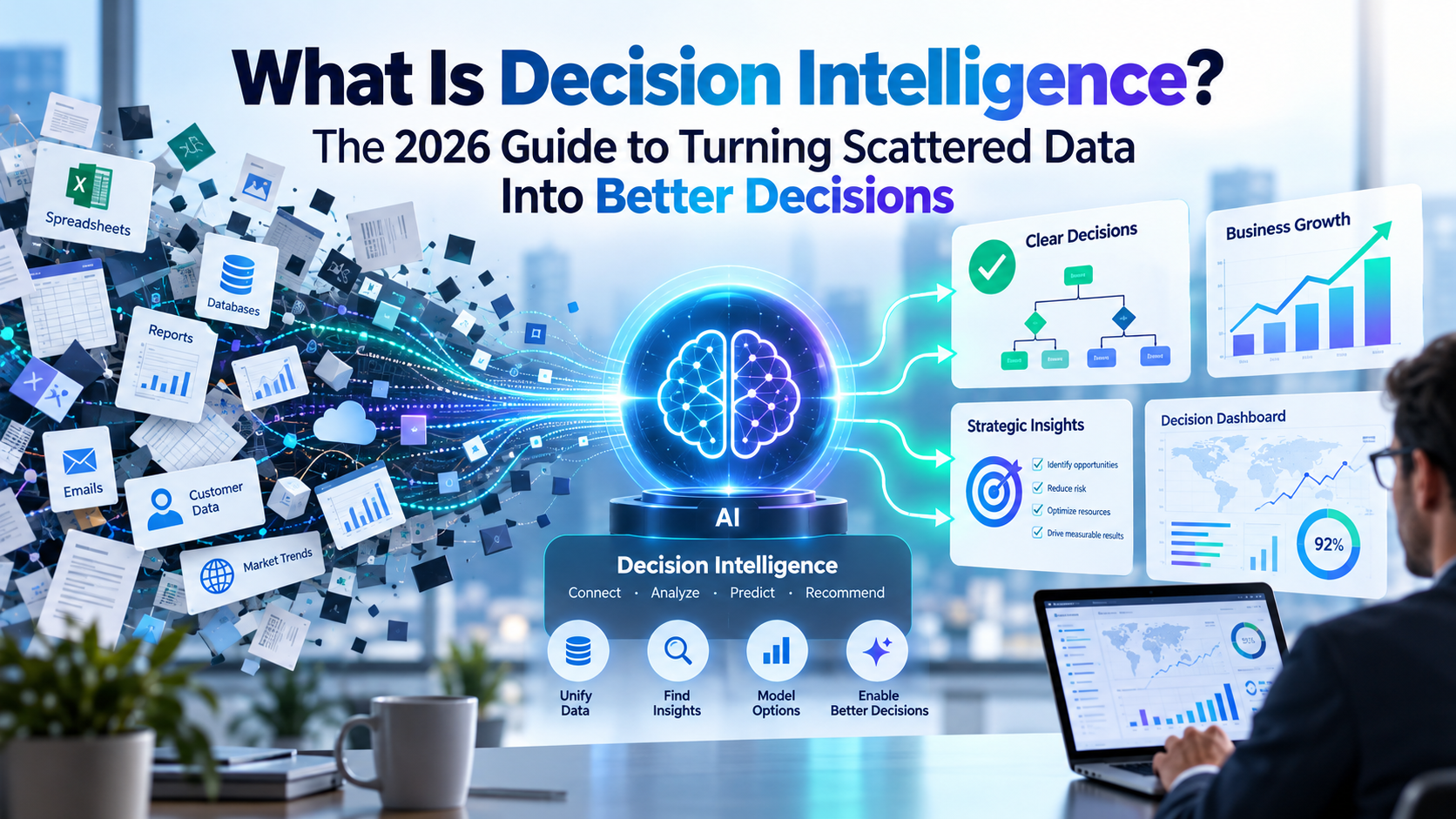

| Quick Answer Decision intelligence is the practice of designing important decisions first, then using data science, AI, statistics and domain expertise to support them. Unlike business intelligence, which reports on the past, decision intelligence combines scattered data into validated recommendations, forecasts and alerts that tell leaders what to do next. In 2026, it is how organizations get real value from AI instead of more dashboards. |
Key Takeaways
- Decision intelligence starts with the decision, not the data.
- It goes beyond business intelligence by predicting outcomes and recommending actions.
- Gartner predicts that through 2026, organizations will abandon 60% of AI projects unsupported by AI-ready data.
- Validation, meaning checking source quality and confirming findings with experts, is what makes recommendations trustworthy.
- Patira Data Science builds decision intelligence for businesses, governments, NGOs and health programs across the US and Uganda.
What Is Decision Intelligence?
Most organizations are not short on data. They are short on clear answers. Sales figures sit in one system, field reports in another, public datasets and maps somewhere else. Leaders still end up deciding on instinct because nobody has connected the pieces.
Decision intelligence fixes that. TechTarget describes it as a field that “combines data science, artificial intelligence (AI) and decision theory to improve organizational decision-making.” Gartner frames it more narrowly as “the process of documenting and engineering how decisions are made.” Both point to the same shift: build the analytics around a decision someone actually has to make.
Decision Intelligence vs. Business Intelligence vs. Data Science
| Question | Business Intelligence | Data Science | Decision Intelligence |
| Main goal | Report what happened | Find patterns and build models | Improve a specific decision |
| Typical output | Dashboards and reports | Models and analyses | Recommendations, forecasts, alerts, APIs |
| Looks | Backward | Backward and forward | Forward, tied to action |
| Data sources | Mostly internal systems | Whatever the project needs | Internal, public, geospatial and research data, integrated |
| Who uses it | Analysts and managers | Data teams | Decision-makers at every level |
| Automation | Rarely | Sometimes | Can automate routine decisions under set rules |
Decision intelligence vs business intelligence vs data science compared.
New to the terminology? Our guide to AI vs. machine learning vs. data science explains how these fields fit together.
Why Decision Intelligence Matters in 2026
AI budgets are growing, but results are uneven. According to Gartner, “through 2026, organizations will abandon 60% of AI projects unsupported by AI-ready data,” and 63% of organizations either do not have, or are unsure whether they have, the right data management practices for AI.
The lesson is clear. Buying an AI tool does not create better decisions. Organizations that win define the decision, prepare the right evidence and validate the output before anyone acts on it. That is exactly what decision intelligence is designed to do.
What Does AI-Ready Data Look Like?
AI-ready data is not simply “a lot of data.” It is data that fits the decision you want to make. In practice, it has five qualities:
| Quality | What It Means | Warning Sign |
| Relevant | Covers the people, places and time periods the decision affects | Models trained on data from a different market or population |
| Accurate | Errors, duplicates and gaps are measured and fixed | Teams argue over which report has the right number |
| Documented | Sources, definitions and update schedules are recorded | Only one analyst knows how a key table was built |
| Governed | Clear ownership, access rules and privacy controls | Sensitive records shared by email or spreadsheet |
| Connected | Internal, public and geospatial sources can be linked | Every dataset uses different IDs, names or formats |
The five qualities of AI-ready data for decision intelligence.
Getting these right is usually the fastest way to make an existing AI investment start paying off.
How Does Decision Intelligence Work?
At Patira, every decision intelligence engagement follows five steps:
- Understand the decision problem. Define the operational, policy, research or business decision the system must support, and who makes it.
- Integrate the evidence. Combine institutional records, public data, geospatial layers and research findings into one view.
- Build the intelligence. Apply data science, AI, GIS, statistics and domain expertise to forecast outcomes and compare options.
- Validate. Assess source quality, corroborate findings and verify results with experts or in the field.
- Deliver decision support. Put answers where people work: dashboards, alerts, briefs, models, APIs or integrated systems.
Decision Intelligence Examples by Sector
Business and Commerce
Retailers and service companies use decision intelligence for pricing and revenue optimization, demand forecasting, churn prediction, fraud detection and root-cause analysis of customer experience problems. Explore our business intelligence and artificial intelligence services.
Public Health and Medicine
Health programs combine clinical, laboratory and surveillance data to spot outbreaks early, track antimicrobial resistance and target scarce resources. Patira’s One Health work on pandemic preparedness and AMR applies this approach. See our medical and public health case studies.
Government, Climate and NGOs
Public agencies and development organizations use geospatial evidence and program data to decide where to invest, which communities are most at risk and whether interventions are working. Read our government, climate and NGO case studies.
Research
Research teams use statistics and bioinformatics to turn complex datasets into publishable, defensible conclusions. Patira also offers bioinformatics and statistics training to build in-house capability.
Is Your Organization Ready for Decision Intelligence?
Use this quick checklist. If you answer “no” to three or more, start with a data readiness review before investing in AI.
- Can you name the top three decisions you want to improve this year?
- Do you know where the data behind those decisions lives?
- Is that data accurate, documented and updated on a schedule?
- Can you combine internal records with public or geospatial data?
- Does someone own data quality and governance?
- Will decision-makers trust a recommendation they did not build themselves?
- Do you have a way to measure whether decisions improved?
Common Mistakes to Avoid
- Starting with the tool instead of the decision. Technology chosen first rarely fits the real problem.
- Building more dashboards. If nobody acts on a chart, it is not decision support.
- Skipping validation. Unverified sources create confident but wrong answers.
- Ignoring the people. Recommendations must fit how teams actually work, or they will be ignored.
Avoiding these four mistakes matters more than choosing any single platform, model or vendor. The best decision intelligence systems are simple, trusted and used every day.
Why Organizations Choose Patira Data Science
Patira Data Science is a global data science and intelligence company with offices in Westerville, Ohio and Kampala, Uganda. We integrate institutional, public, geospatial and research evidence into one intelligence system, validate it with expert and field verification, and deliver it in the format your team will use. Our work spans business, healthcare technology, public health, climate and environment, government and NGOs. Learn more about Patira or explore our research and data analysis services.
Frequently Asked Questions
What is decision intelligence in simple terms?
Decision intelligence is the practice of designing decisions first, then using data science, AI and domain expertise to support them. Instead of producing more reports, it delivers recommendations, forecasts and alerts tied to a specific decision someone has to make.
How is decision intelligence different from business intelligence?
Business intelligence reports on what already happened through dashboards and reports. Decision intelligence adds predictive models, AI and decision design to recommend what to do next, and can automate routine decisions based on set rules.
Is decision intelligence the same as AI?
No. AI is one of the tools decision intelligence uses. Decision intelligence also relies on statistics, geospatial analysis, validated data sources and human expertise to make sure recommendations are trustworthy.
What does AI-ready data mean?
AI-ready data is data that is accurate, well-documented, governed and representative of the problem you want to solve. Gartner predicts that through 2026, organizations will abandon 60% of AI projects unsupported by AI-ready data.
Which industries use decision intelligence?
Decision intelligence is used in retail, finance, healthcare, public health, government, climate and environment programs, NGOs and research, anywhere repeated decisions depend on large or scattered data.
How do I get started with decision intelligence?
Start with one high-value decision, map the data behind it and run a focused pilot. Patira Data Science helps organizations scope the decision, integrate and validate the evidence, and deliver dashboards, alerts, models or APIs. Call (614) 398-3398 or email hello@patiradatascience.com.
Turn Your Data Into Decisions
| Have too much data and not enough answers? Tell us the decision you need to get right. We will show you what evidence you already have, what is missing and how decision intelligence can close the gap. Talk to an Advisor | Call (614) 398-3398 | Email hello@patiradatascience.com |