
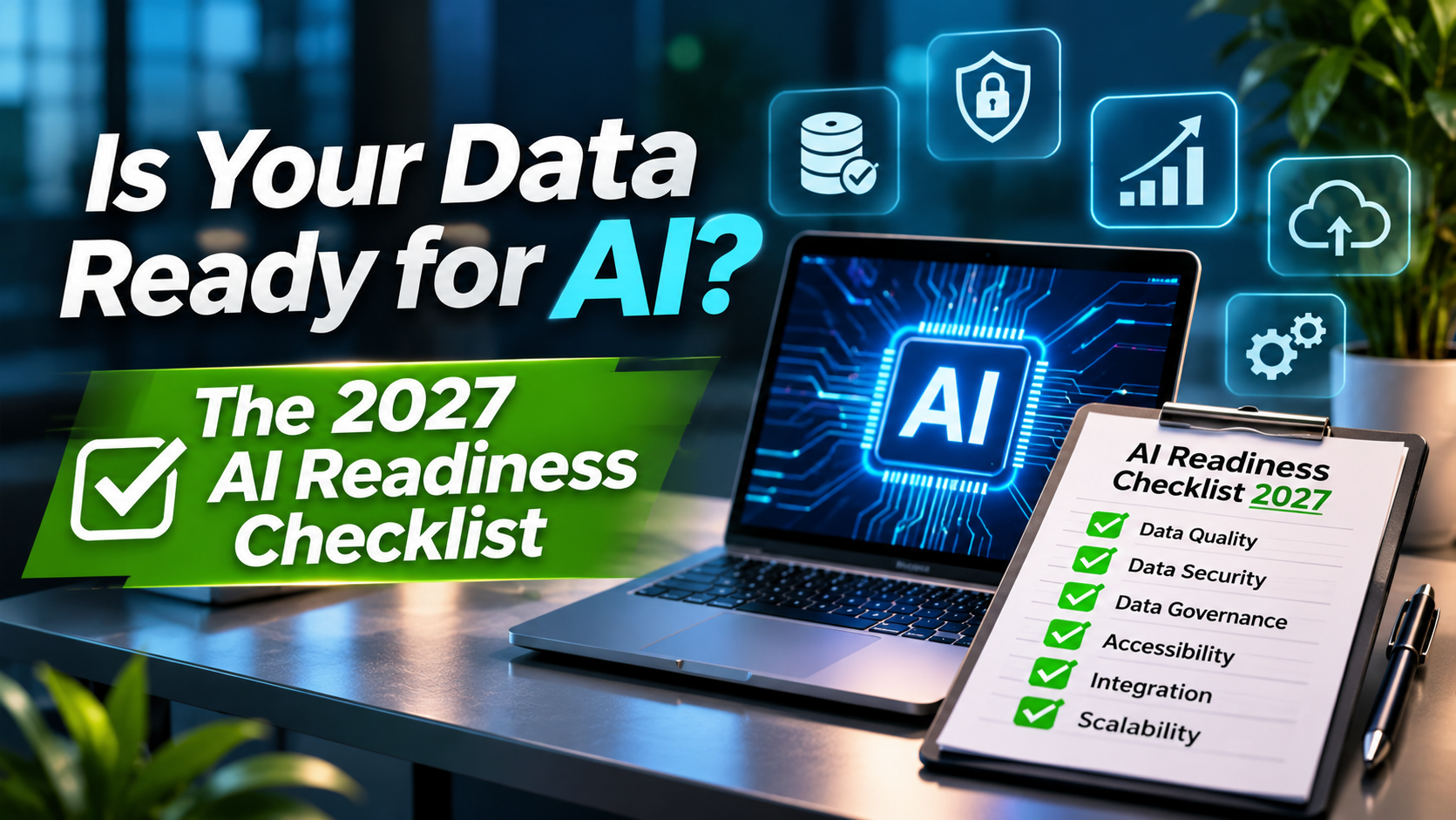

| Quick Answer Your data is ready for AI when it is accurate, accessible, connected across systems, governed, current and representative of the real situations your AI will face, and when it is tied to one clear decision you want to improve. Most AI projects stall because this step is skipped. Gartner predicts that through 2026, organizations will abandon 60% of AI projects unsupported by AI-ready data. Use the 10-question checklist below to score your readiness before you invest. |
Every organization wants AI in its 2027 plan. Leaders have seen the demos, vendors are calling, and boards are asking what the AI strategy is. But behind the excitement is an uncomfortable pattern: most AI pilots never deliver real value. The reason is rarely the AI model itself. It is the data underneath it.
This guide explains what AI-ready data actually means, why so many projects fail without it, and gives you a simple checklist to score your own organization in about 10 minutes.
Why Most AI Projects Stall
The research is consistent:
- Gartner found that 63% of organizations either do not have, or are unsure if they have, the right data management practices for AI. It predicts that through 2026, organizations will abandon 60% of AI projects unsupported by AI-ready data (Gartner, February 2025).
- MIT’s GenAI Divide report found that about 95% of corporate generative AI pilots failed to deliver measurable financial returns. The main problem was not the models, but how poorly the tools fit into real workflows (report coverage).
- Gartner’s 2026 research found that organizations with successful AI initiatives invest up to four times more, as a share of revenue, in foundations such as data quality, governance and change management than those with poor results (Gartner, April 2026).
The lesson is simple: AI success is decided before the AI is built.
What “AI-Ready Data” Actually Means
AI-ready data is not the same as “a lot of data”. It is data that fits the specific problem you want to solve. Gartner puts it this way: the data must be representative of the use case, including its patterns, errors, outliers and unexpected cases.
| Quality | What it means in practice |
| Fit for purpose | Linked to a specific decision or question, not collected “just in case” |
| Accurate | Errors, duplicates and missing values are known and managed |
| Accessible | The right people and systems can reach it, not just one spreadsheet owner |
| Connected | Records from different systems can be matched and combined |
| Current | Updated often enough for the decision it supports |
| Representative | Covers real-world variety, including unusual cases, so the AI is not biased or blind |
| Governed | Clear ownership, privacy rules and permission to use it |
| Documented | People know what each field means and where it came from |
The 10-Question AI Readiness Checklist
Answer each question Yes (2 points), Partly (1 point) or No (0 points).
- Do we have one clear decision or problem we want AI to improve? Not “use AI”, but something like “predict which clients will churn” or “forecast demand by region”.
- Do we know where all the data for that decision lives? Systems, spreadsheets, documents, external sources.
- Can we combine data from those sources using shared IDs, dates or locations?
- Is the data accurate enough that we already trust it for reports and decisions?
- Do we have enough history to show patterns, such as at least a few cycles of the thing we want to predict?
- Is the data updated often enough for the decision, such as daily, weekly or monthly?
- Does the data include unusual cases and different groups, not just the typical ones?
- Do we have permission to use it for AI, including privacy, consent and contract terms?
- Is there a named owner responsible for each key dataset?
- Will the people who make the decision actually use the AI output in their daily workflow?
Your score
| Score | What it means | Next step |
| 16 to 20 | AI-ready for this use case | Move to a focused pilot with clear success measures |
| 10 to 15 | Partly ready | Fix the gaps that matter for this use case first, then pilot |
| 0 to 9 | Not ready yet | Start with data integration, quality and a clear decision before buying AI tools |
5 Common Data Gaps and How to Fix Them
1. Data scattered across systems
Finance in one tool, operations in another, field reports in PDFs. Fix: map your sources and build a single integrated view for the decision you care about.
2. Inconsistent definitions
“Customer”, “case” or “region” means something different in each department. Fix: agree on shared definitions and document them in a simple data dictionary.
3. Valuable information locked in documents
Reports, scanned forms and emails hold critical facts that never reach a database. Fix: use document extraction to turn unstructured records into usable data.
4. Missing location context
Many decisions depend on where things happen: service areas, supply routes, disease spread, climate risk. Fix: add geospatial data to reveal patterns that tables alone miss.
5. No feedback loop
Models are built once and never checked again. Fix: validate results against real outcomes and set up monitoring so performance does not quietly decline.
AI Readiness for NGOs, Health and Public Sector Teams
Government agencies, research groups and global health programs face extra challenges: data from many partners, strict privacy rules, paper records and limited budgets. For these teams, AI readiness also means protecting sensitive information, documenting data sources for funders and auditors, and making sure results are explainable to the people who rely on them. Learn more about Patira’s work in global health and research and analytics.
A Simple 90-Day Plan to Get AI-Ready
| Timeline | Focus |
| Days 1 to 30 | Pick one high-value decision. Map the data sources. Score readiness with the checklist. |
| Days 31 to 60 | Fix the critical gaps: integrate sources, clean key fields, agree on definitions, confirm permissions. |
| Days 61 to 90 | Run a focused pilot, validate results against real outcomes and plan how it fits into daily work. |
Once your data is ready, you can move to forecasting for 2027 budgets, AI agents or full decision intelligence with far less risk.
How Patira Data Science Helps
Patira builds intelligence systems that bring together scattered data, documents, public information, geospatial evidence and institutional records. Our process follows five steps: define the decision, integrate evidence, build intelligence, validate and deliver decision support. That means the readiness work is built in from day one, not discovered after a failed pilot.
- Artificial Intelligence: custom AI, chatbots, predictive models and recommendation engines
- Business Intelligence: forecasting and predictive analytics
- Research and Analytics: data collection, review and analysis
Frequently Asked Questions
What is AI-ready data?
AI-ready data is data that fits the specific problem you want AI to solve. It is accurate, complete enough, connected across systems, well documented, legally usable and representative of real situations, including errors, outliers and unusual cases.
Why do most AI projects fail?
Research points to the same causes: data that is not ready, AI that is not connected to real workflows, and no clear decision or business goal. Gartner predicts organizations will abandon 60% of AI projects unsupported by AI-ready data through 2026.
How do I know if my organization is ready for AI?
Start with one decision you want to improve, then check whether the data behind it is accurate, accessible, connected, governed and current. The 10-question checklist in this guide gives you a quick score.
Do small organizations need perfect data before using AI?
No. You need data that is good enough for one focused use case. Start small, fix the gaps that matter for that use case, and expand from there.
How long does it take to make data AI-ready?
It depends on how scattered your data is and how complex the use case is. A focused readiness assessment shows the gaps and a realistic timeline before you commit to a larger build.
Should we build our own AI or work with a partner?
The MIT GenAI Divide report found that tools bought from or built with external partners succeeded about two-thirds of the time, compared with about one-third for internal builds. The right choice depends on your data, team and goals.
| Find Out If Your Data Is Ready for AI Talk to a Patira advisor about your 2027 AI plans. We will help you identify the decision that matters most, review the data behind it and show you what it takes to get AI-ready. Call: (614) 398-3398 | Email: hello@patiradatascience.com Talk to an Advisor |